Commercial Streets · c. 1905
Commercial Street, c. 1905
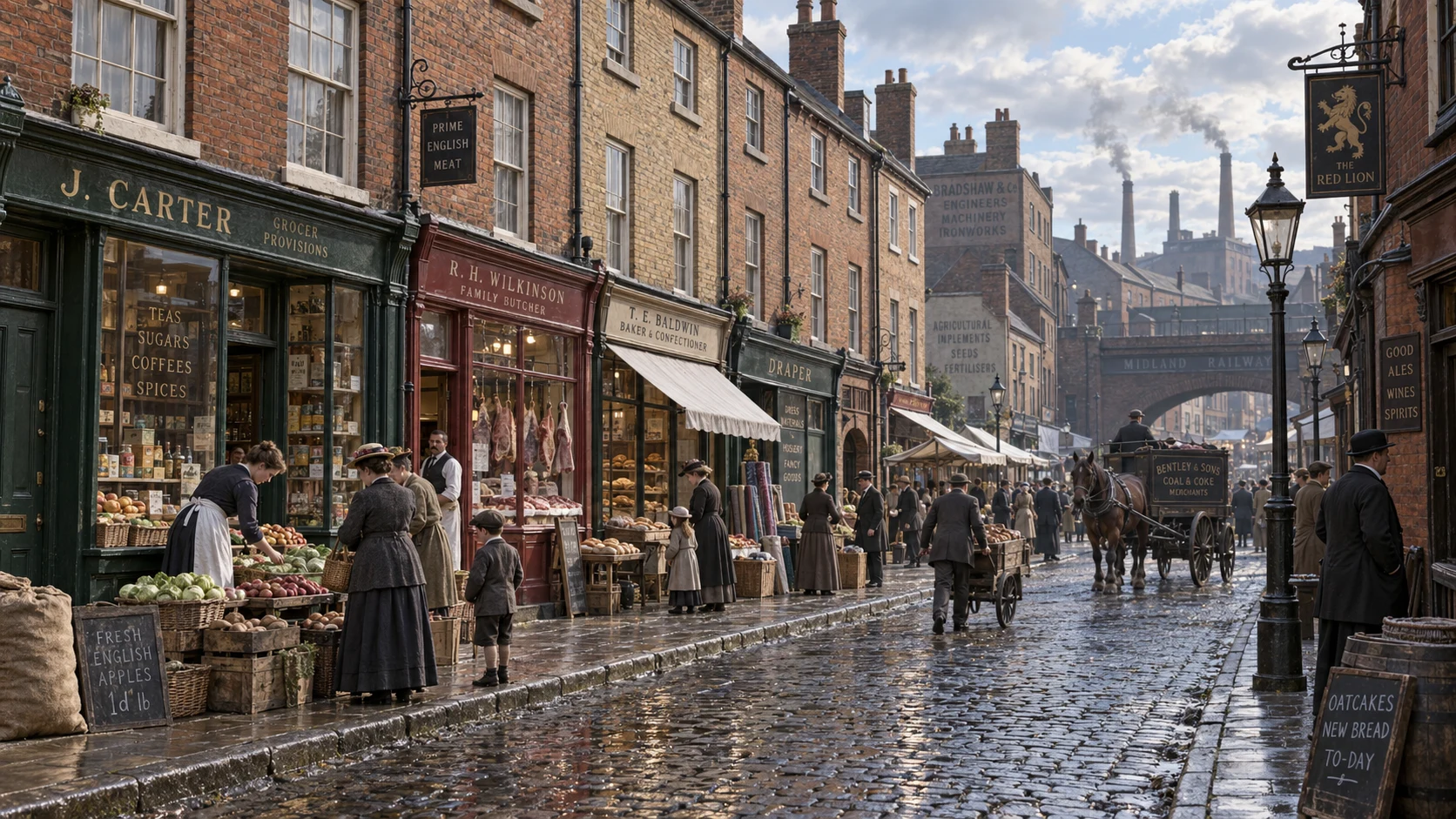
An AI-generated historical interpretation of commercial streets in Britain, c. 1905. The scene is presented without attribution to a specific real location.
This work is an AI-generated historical interpretation and does not claim to depict a specific real location.
- Period
- c. 1905
- Country
- Britain
- Category
- Commercial Streets
- Image
- AI-generated historical reconstruction
- Status
- Interpretation
Generation prompt
Create a panoramic, photorealistic reconstruction of an ordinary English market street in the Midlands around 1905.

Show a local market street on a Saturday morning in early October, around 8:30 am, after overnight rain. The weather is cool and brightening, with broken clouds and soft sunlight beginning to reach parts of the street. The road and pavements are still damp, with subtle reflections in the cobbles and stone slabs.

This is not a grand city centre boulevard and not a romantic fantasy. It is a practical, busy, medium-sized Midlands town street, slightly sooty, commercially active, and built up gradually during the 19th century. The architecture must feel historically grounded, ordinary, and functional.

Street character and layout

In the foreground show:

a row of small independent shops in narrow buildings,
mixed-use buildings with shops on the ground floor and living accommodation above,
timber shopfronts with recessed entrances,
separate narrow doors leading to upper floors,
modest hanging signs and fascia boards, with no dominant readable modern-style text,
a few temporary market stalls or awnings extending into the street edge.

Further along the street show:

additional shops and terraced buildings,
a butcher, greengrocer, baker, draper or ironmonger implied through displays,
a small public house or corner premises,
a side archway leading to a yard,
in the distance a modest industrial presence: warehouse roofs, a railway bridge, or a few factory chimneys, but the market street remains the main subject.
Architecture

Buildings must have:

narrow frontage widths based on real urban plots,
2–4 storeys,
aligned vertical window axes,
taller commercial ground floors and slightly lower upper storeys,
authentic vertical sash windows,
smaller, plainer top-floor windows,
brick façades in red, orange, and yellow stock brick,
stone lintels or brick arches,
simple stone sills,
painted timber shopfronts in dark green, brown, black, deep red, or cream,
slate roofs,
logically arranged chimneys attached to party walls,
cast-iron gutters and downpipes.

Terraced buildings must share full party walls. Do not show side windows where buildings adjoin. Roofs must be structurally correct, with full roof slopes, ridges, eaves, flashing, and sensible chimney connections.

Street life

This is a busy but ordinary market morning:

local residents, shopkeepers, stallholders, porters, errand boys, and customers,
working- and lower-middle-class Edwardian clothing,
no fashionable parade crowd,
crates, baskets, sacks, and produce outside shops,
handcarts and one horse-drawn delivery wagon,
women inspecting vegetables or bread,
a shop assistant setting out goods,
a few children accompanying adults,
gas street lamps present but unlit, because it is daytime.
Materials and atmosphere

The scene should feel lived-in and materially convincing:

damp cobbles,
worn stone kerbs and paving slabs,
lightly sooty brickwork,
slightly weathered painted wood,
old imperfect shop glass,
subtle smoke from distant chimneys,
cool autumn air with a faint industrial haze.
Composition

Format 16:9.
Camera height around 1.65 m, placed near the edge of the pavement.
Show the street at a slight angle, so the viewer can clearly read the façades, shopfront depth, rooflines, and progression of the street.
Architecture must dominate the composition. Do not overcrowd the image with people, carts, or decorations.

Avoid

Avoid:

grand ceremonial avenues,
overly ornate architecture everywhere,
American-style storefronts,
modern windows, signage, lamp posts, vehicles, wires, or road markings,
trams or tram tracks,
excessive crowd density,
theatrical steampunk styling,
overly clean or nostalgic postcard aesthetics,
text copied from source plates,
glowing street lamps in daytime.

Final effect: a believable, lively, working English market street in the Midlands in autumn 1905, historically grounded, slightly weathered, commercially active, and useful as reference for modular 3D environment modelling.