Industrial Streets · c. 1905
Industrial Street, c. 1905
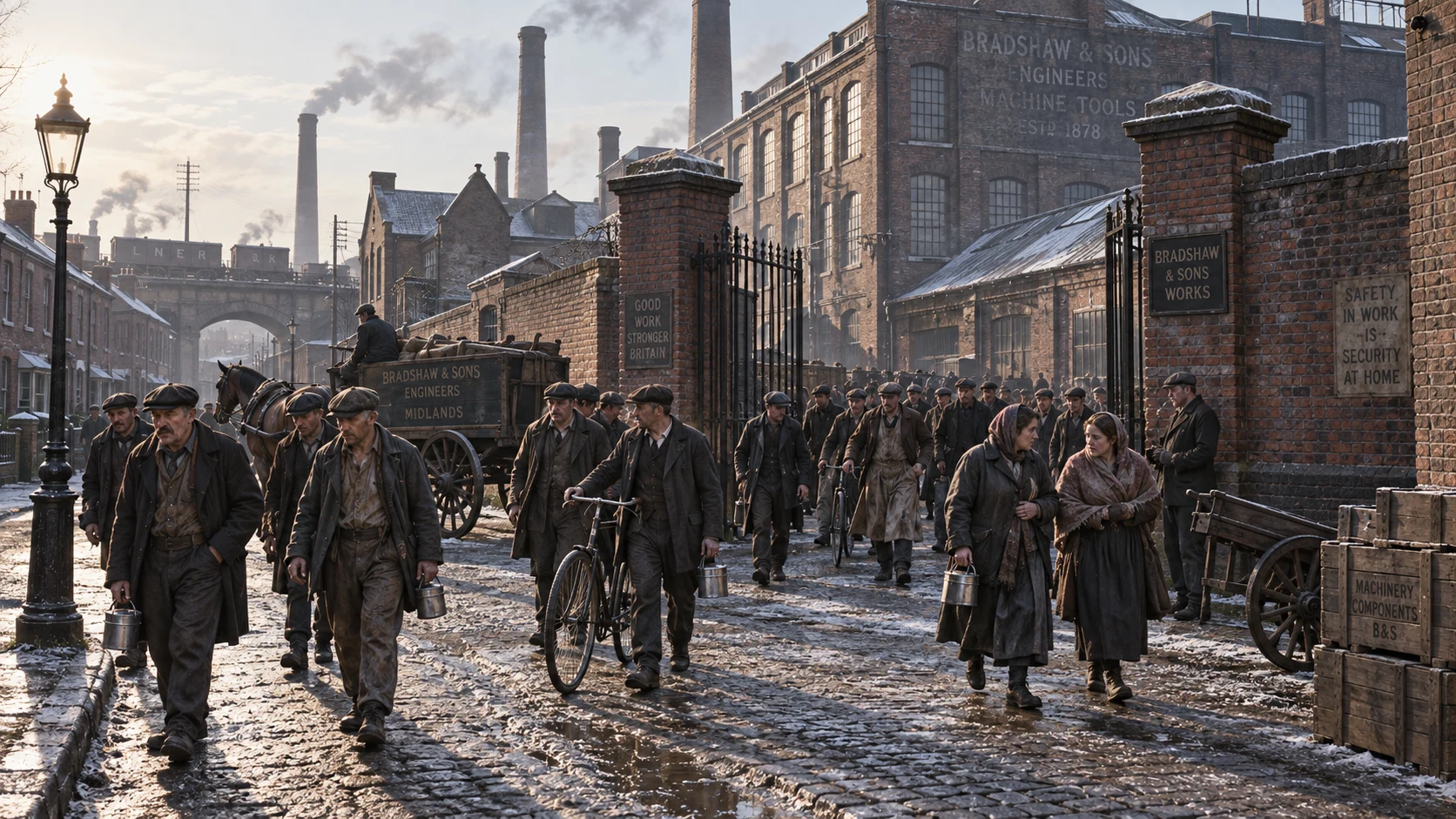
An AI-generated historical interpretation of industrial streets in Britain, c. 1905. The scene is presented without attribution to a specific real location.
This work is an AI-generated historical interpretation and does not claim to depict a specific real location.
- Period
- c. 1905
- Country
- Britain
- Category
- Industrial Streets
- Image
- AI-generated historical reconstruction
- Status
- Interpretation
Generation prompt
Create a panoramic, photorealistic reconstruction of a factory shift change in an English industrial town in the Midlands around 1905.

Show the moment when workers are leaving a large factory complex at the end of a shift. The setting is a winter morning in January 1905, with a thin frost, low pale sunlight, and a cold, slightly smoky atmosphere. The light should be crisp and low, casting long shadows, while the air remains harsh, industrial, and subdued rather than picturesque.

This is not a grand or heroic industrial scene. It is an ordinary, working industrial district in a medium-sized English town: practical, soot-stained, crowded near the gates, and shaped by everyday labour.

Main subject

The main focus is the factory entrance and the street immediately outside it.

Show:

a large brick factory or engineering works with a substantial entrance gate,
workers coming out of the gates at the end of a shift,
a modest crowd of men and a few women in practical Edwardian working clothes,
caps, heavy coats, aprons, scarves, boots, lunch tins, and work-worn clothing,
several bicycles,
one or two horse-drawn carts or delivery wagons,
a few workers walking away in groups,
some workers lingering briefly near the gate,
a sense of routine, fatigue, and everyday industrial life.

The crowd should feel real and functional, not theatrical and not overpacked. This is a winter morning, so there should be fewer people than in a busy market scene, but still enough to convey shift change.

Architecture and industrial setting

The factory complex should be historically convincing for industrial England around 1905.

Include:

large brick industrial buildings,
tall multi-pane factory windows,
workshop roofs and attached yard buildings,
a gatehouse or brick entrance structure,
chimney stacks with light smoke,
yard walls, loading doors, and service entrances,
soot-darkened brickwork,
iron gates and practical industrial detailing,
nearby rows of plain terraced houses or small workshops if visible,
perhaps a railway bridge, warehouse, or secondary chimney in the distance.

The industrial complex should feel substantial, but the view should remain at street level, with the workers and the entrance as the central focus.

Street and environment

The street outside the works should include only historically appropriate elements:

cobbled or hard-packed road surface,
patches of frost and dampness,
stone pavements and kerbs,
mud, ash, and traces of grime,
no motor vehicles,
no modern street furniture,
gas lamps present but unlit in daylight,
wooden crates, barrels, sacks, or industrial materials near the walls,
possibly a handcart near the entrance.
Atmosphere

The atmosphere should be cold, austere, and realistic:

thin frost on the ground and roof edges,
low winter sunlight,
pale sky with slight haze,
subtle smoke drifting from chimneys,
visible coldness in the air,
a restrained industrial mood,
a town shaped by work, not spectacle.

Avoid romantic fantasy or exaggerated steampunk styling. The scene should feel like a believable historical reconstruction.

Composition

Format 16:9.

Camera height around 1.65 m, positioned near the edge of the street or pavement, looking diagonally toward the factory gates so that both the workers and the industrial buildings are clearly visible.

The image should read well as a reference for modular 3D environment modelling. The architecture must be clear, structurally logical, and visually dominant, while the crowd supports the scene without obscuring it.

Materials

Materials must feel natural and historically grounded:

weathered red and brown brick,
soot stains,
worn stone kerbs,
frosty cobbles,
old glass,
painted timber details where appropriate,
iron gates and railings,
slate roofs,
light smoke and winter haze.
Avoid

Avoid:

modern cars, buses, bicycles with modern styling, or electric lighting,
romantic golden fantasy lighting,
huge theatrical smoke clouds,
American-style factories,
excessive crowd density,
monumental or decorative civic architecture,
readable modern signs,
steampunk gadgets,
clean, idealised surfaces,
cinematic exaggeration that overwhelms the historical realism.

Final effect: a believable, slightly harsh, visually rich reconstruction of a factory shift change in industrial England, January 1905, with workers leaving a brick factory in low winter sunlight, thin frost underfoot, smoke in the air, and the practical architecture of everyday industrial life clearly visible.