Industrial Streets · c. 1905
Industrial Street, c. 1905
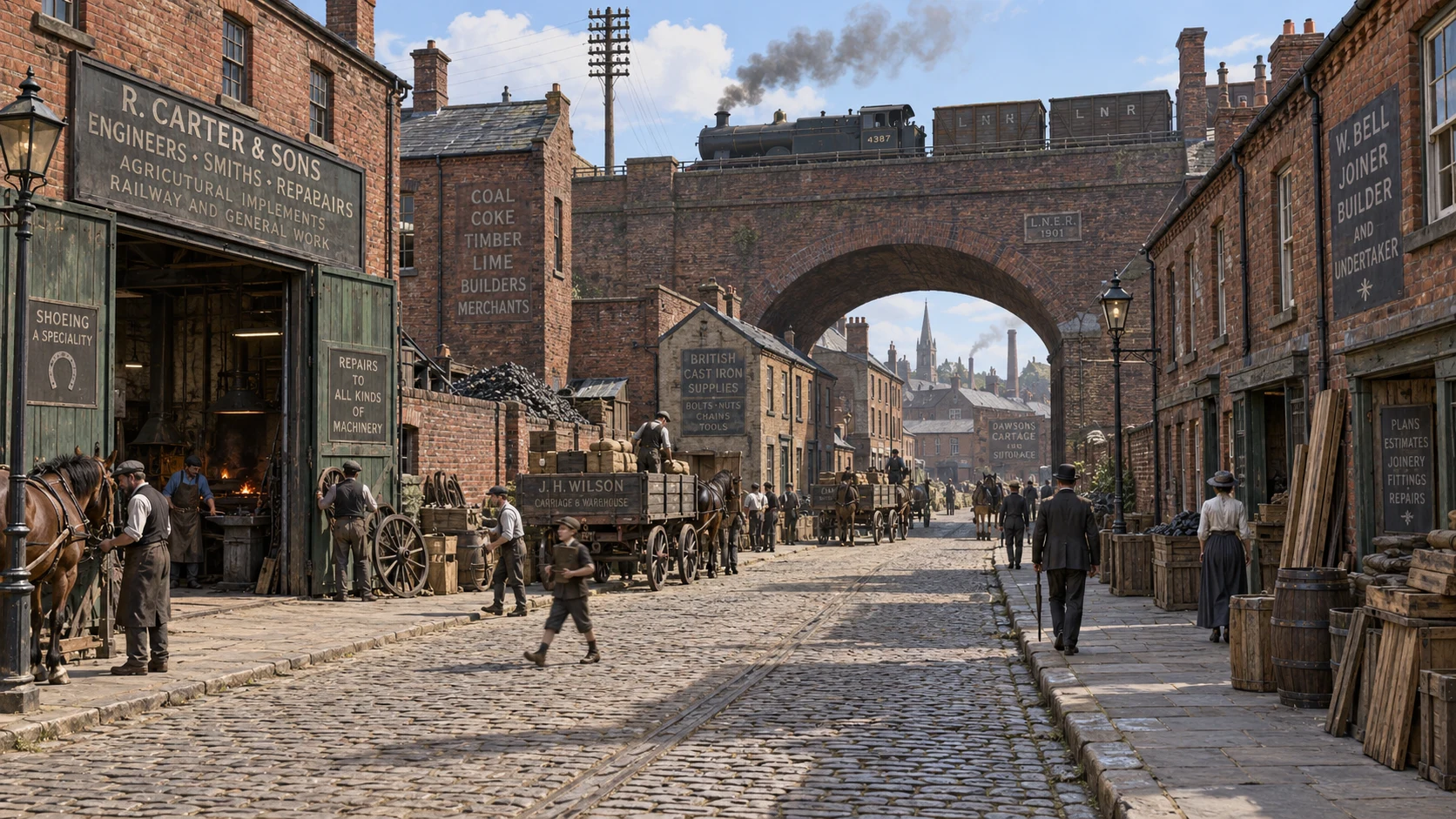
An AI-generated historical interpretation of industrial streets in Britain, c. 1905. The scene is presented without attribution to a specific real location.
This work is an AI-generated historical interpretation and does not claim to depict a specific real location.
- Period
- c. 1905
- Country
- Britain
- Category
- Industrial Streets
- Image
- AI-generated historical reconstruction
- Status
- Interpretation
Generation prompt
Create a panoramic, photorealistic reconstruction of a railway quarter in an English industrial town in the Midlands around 1905.

Show a street running beneath or toward a railway viaduct, lined with small workshops, storage yards, modest warehouses, and mixed residential-industrial buildings. The setting is a summer afternoon in June 1905, with dry streets, clear bright light, and warm but natural daylight. The atmosphere should feel more open and pleasant than a winter or rainy scene, but still grounded in the reality of an industrial town.

This is not a romantic postcard and not a grand railway station district. It is a working railway quarter: practical, slightly worn, soot-marked in places, and shaped by transport, commerce, and everyday labour.

Main subject

The main focus is the street itself and its relationship to the railway infrastructure.

Show:

a cobbled or hard-packed street leading under or toward a brick railway viaduct,
small workshops such as smithies, repair shops, joiners, mechanics, or ironmongers,
small depots or yards with crates, barrels, sacks, timber, coal, or tools,
horse-drawn carts and wagons moving goods,
a few horses standing or being loaded,
several working people: carters, labourers, mechanics, errand boys, shopkeepers, and residents,
a modest flow of pedestrians,
a steam locomotive visible in the background, either crossing the viaduct or glimpsed beyond it,
a sense that rail transport is a daily presence in the district.

The street should feel active, but not overcrowded. This is a functional quarter of a medium-sized industrial town, not a major city centre.

Architecture and urban setting

The architecture must feel historically grounded for industrial England around 1905.

Include:

rows of modest brick buildings,
a mix of terraced housing, workshops, yard buildings, and small commercial premises,
tall workshop doors and loading openings,
multi-pane industrial windows,
small signs or painted shop boards appropriate to the period,
brick boundary walls,
chimneys and slate roofs,
cast-iron gutters and downpipes,
an imposing but ordinary railway viaduct of brick arches,
possibly a small railway bridge, retaining walls, telegraph poles, or warehouse extensions,
in the distance, hints of a broader industrial townscape.

The railway viaduct should be a major visual anchor, but it must sit naturally within the street rather than dominate the scene like a monument.

Street life and atmosphere

The scene is a dry, bright summer afternoon, so the mood is clearer and slightly lighter than the darker industrial scenes, while still realistic.

Show:

workers moving goods,
people walking home or between jobs,
carts paused near workshops,
small deliveries and yard activity,
practical everyday Edwardian clothing,
no fashionable crowd and no theatrical posing,
sunlight falling across brickwork and cobbles,
some soot and wear, but not heavy mud or rain.

Gas street lamps may be present, but they must be unlit in daylight.

Materials and environment

Materials should feel realistic and useful as reference for 3D modelling:

dry cobbles or compacted road surface,
worn stone kerbs and pavements,
red, orange, and brown brick with some soot staining,
weathered painted timber doors and shopfront details,
iron railings, gates, or workshop fittings,
old glass,
slate roofs,
timber carts and barrels,
subtle smoke from distant chimneys and from the locomotive.

The atmosphere should suggest a working industrial district in fair weather, not a fantasy or overly polished heritage reconstruction.

Composition

Format 16:9.

Camera height around 1.65 m, positioned at street level and angled so the viewer can clearly read the façades, the road alignment, the viaduct, and the layered depth of the quarter.

Architecture should occupy most of the composition. The people, carts, and animals should support the realism of the setting without blocking the buildings.

The image should be useful as reference for modular 3D environment modelling in Blender or Godot.

Avoid

Avoid:

grand stations or monumental civic railway architecture,
modern vehicles or street furniture,
tram tracks,
overly decorative shopfronts,
American-style industrial buildings,
fantasy steampunk machinery,
excessive smoke or dramatic cinematic fog,
overly clean or idealised surfaces,
dense crowds that obscure the built environment,
readable modern typography or modern signage.

Final effect: a believable, bright, historically grounded reconstruction of a railway quarter in industrial England, June 1905, with a street beneath a railway viaduct, workshops and small depots, carts and horses, a steam locomotive in the background, and the mixed residential-industrial character of everyday urban life clearly visible.